The Yijin Jing(Yijin Jing)
1. A Multidimensional System for Physical Practice
The Yijin Jing (Classic of Tendon Transformation) is a classic text of mind-body cultivation originating in late imperial China. Its core is not a set of martial arts routines or simple Qigong exercises, but an integrated life science system designed to systematically optimize the human body's musculoskeletal structure, neural conduction, and energy metabolism through specific postures, breath, and conscious regulation. It aims for a qualitative shift from an "ordinary body" to an "optimized body," and its principles resonate with modern scientific understandings of "body plasticity" and "biomechanical remodeling."
2. The Multidimensional Meaning of "Yijin"
The term "Yijin" reveals the text's fundamental principle:
- "Yi" (易): Signifies change, transformation, and upgrading. This refers not only to physical changes but also to neural adaptation, fascial network reorganization, and improved energetic efficiency.
- "Jin" (筋): Does not mean just muscle. It encompasses the entire tensile network of tendons, ligaments, fascia, nerves, and connective tissues—what modern anatomy terms the "myofascial meridians" and "kinetic chains."
Thus, the essence of the Yijin Jing is an operational program for the intelligent restructuring of the body's inherent architecture through conscious guidance. Its postures (commonly twelve or more) form a progressive "body re-education" project.
3. A Threefold Progressive Path
Practice typically follows an internal logic, advancing through three integrated layers:
3.1 First Layer: Correct Form Generates Strength (Remodeling Body Structure)
- Goal: Correct biomechanical imbalances from daily posture, establishing a centered and stable physical framework.
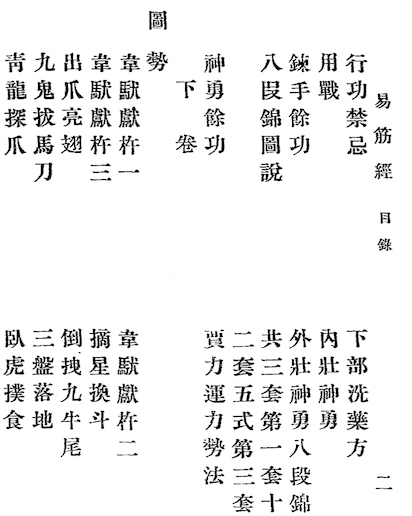
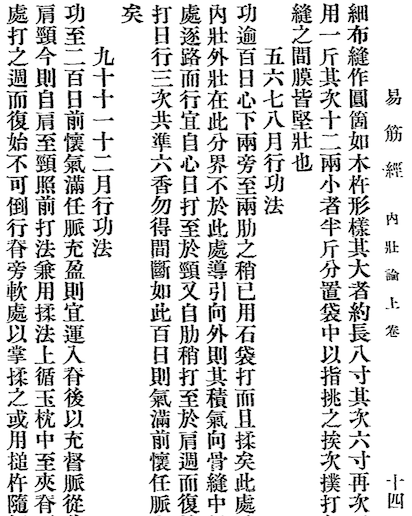
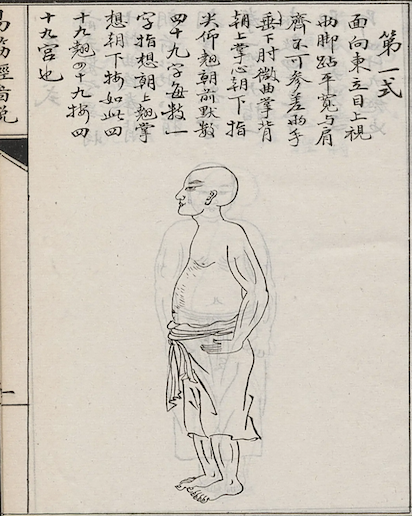
- Method: Using static or slow-moving postures (e.g., "Weituo Presenting the Pestle") to maintain tension at specific angles, retraining deep stabilizer muscles and optimizing bone alignment and joint positioning.
- Outcome: Improved posture, relief from chronic pain, enhanced efficiency of force transmission.
3.2 Second Layer: Qi Flow Infuses Power (Opening Energy Pathways)
- Goal: On a stable structure, awaken and guide the flow of internal energy (Qi and Blood).
- Method: Integrating specific, deep, and even breathing patterns (e.g., "reverse abdominal breathing") with focused intention, guiding awareness into the fascia and spaces around organs.
- Outcome: Increased bodily coordination and sensory acuity, improved stamina and recovery.
3.3 Third Layer: Concentrated Spirit Leads to Transformation (Integrating Body and Mind)
- Goal: Achieve a high degree of unity between form, breath, and spirit, reaching a holistic state where "form follows intention, power arises from the heart-mind."
- Method: Maintaining intense focus and internal relaxation within complex dynamic postures (e.g., "Plucking Stars, Changing the Dipper," "Pulling Nine Oxen by the Tails"), experiencing the flowing sensation of power moving sequentially through the body.
- Outcome: Significantly enhanced neuromuscular control, reaction speed, and mind-body resilience.
Ultimately, the Yijin Jing conveys a profound philosophy of active living: our physical and mental state is not a fixed, unchangeable fact, but a dynamic project that can be remodeled and optimized through consistent, conscious practice. It does not promise quick external results but points to an inward path—one of gaining enduring strength, flexibility, and peace through meticulous work on the architecture of one's own life. In our search for external vigor and internal balance today, this ancient classic continues to shine with universal and practical wisdom.