


The Classic of Mountains and Seas: Primordial Memory of Chinese Civilization and Its Mysterious Geographic Chronicle
I. Origin of the Title: What is the "Classic of Mountains and Seas"?
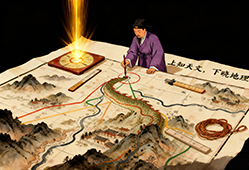
The Classic of Mountains and Seas is an extraordinary ancient Chinese text, compiled roughly between the Warring States period and the early Han dynasty. It represents a unique fusion of mythic geography, folklore, natural studies, shamanistic beliefs, and tribal history. The words "Mountains" and "Seas" reflect the book's grand framework of cataloging the myriad phenomena across land and sea, while "Classic" signifies its authoritative status within ancient knowledge systems. Rather than a work of pure imagination, it is a proto-encyclopedia of early civilization, blending ancestral explorations of the world, orally transmitted myths, and collective memory.
II. Structure and Content: A Mysterious World in Three Dimensions
The surviving text comprises eighteen volumes, divided into two main systems—Classic of the Mountains and Classic of the Seas—constructing a layered cosmic worldview:
Classic of the Mountains (Five Treasuries of the Mountains)
This section bears the strongest geographical character. Organized by direction, it records the locations, products, mythical creatures, and sacrificial rites associated with 447 mountains. While many minerals, plants, and animals are described fantastically (e.g., "eating it prevents hunger," "wearing it prevents deafness"), they may encode early knowledge of the medicinal or practical uses of natural resources, making this work a precursor to Chinese geographical and natural history writing.Classic of the Seas (Overseas and Within Seas Classics)
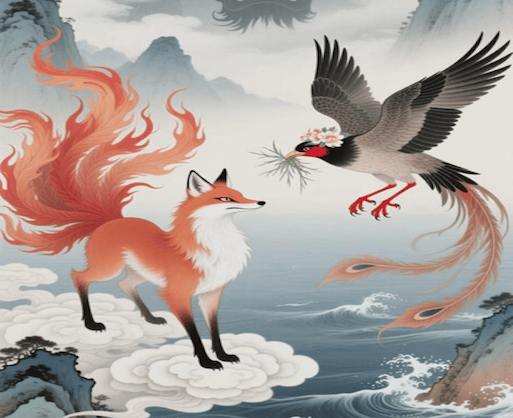
These volumes depict "foreign lands beyond the central plains," such as the Feathered People, the Flame-Eaters, and the Country of Men, brimming with anthropological imagination. While seemingly absurd, these accounts may reflect ancient tribes' rumors about distant peoples, differences in totemic worship, or even faint traces of early cultural exchange.Classic of the Great Wilderness and the Final Chapter of Within Seas
These sections preserve some of the most archaic creation myths and divine genealogies, including well-known tales like "Nüwa Mends the Sky," "Houyi Shoots the Suns," "Kuafu Chases the Sun," and "Jingwei Fills the Sea." Records of deities like Di Jun, the Yellow Emperor, the Yan Emperor, and the Queen Mother of the West form the core material for studying China's ancient mythic systems and religious evolution.
III. Cultural Significance: The Genetic Code of Chinese Civilization
The value of the Classic of Mountains and Seas far exceeds that of a mere collection of strange tales. It is a key to deciphering multiple layers of China's civilizational origins:
A Treasury of Mythic Motifs: Its narratives established the fragmented, regionalized, and historicized nature of Chinese mythology, becoming an inexhaustible source of inspiration for later literature and art—from the fantastical imagery of the Chu Ci to the bizarre creatures in Journey to the West.
A Projection of Geographic Understanding: Its seemingly fictional geography represents the early Chinese spatial cognitive model of the known and unknown world, centered on the Yellow River basin. Recent scholarship has attempted to correlate its mountains and rivers with real geography, proposing various insightful theories.
Fragments of Historical Memory: Accounts like the war between the Yan and Yellow Emperors or Gonggong's crashing into Mount Buzhou may conceal echoes of ancient tribal migrations, conflicts, and integrations—oral history remnants from before the age of written records.
A Living Fossil of Folklore and Shamanism: Its extensive references to sacrifices, shamanic healing, and omens provide precious material for studying primitive religion, magical thinking, and social customs in antiquity.
The Classic of Mountains and Seas is a wondrous text that can never be fully "deciphered." It resembles a mysterious star chart drawn in words, left behind by ancient China—part simple record of mountains and rivers, part divine radiance piercing through time. It reminds us of the profound and magnificent origins of the Chinese imagination. To read the Classic of Mountains and Seas is not merely to look back at the childhood of a civilization but also, amidst modern clamor, to reconnect with humanity's most primal, awe-inspiring curiosity about the world.


Comments
yunfu2025-10-12
你是还